Recycled Glass as a Building Material

This study investigates the feasibility of 3D printing with recycled glasses, focusing on comparing viscosity characteristics and extrusion behaviors of studio soda-lime glass, recycled soda-lime container glass, and recycled float produced window glass. Employing multiple methodologies, we analyzed the temperature-viscosity curves of these glass types, providing an understanding of their thermal properties in relation to 3D printing process and applications. We employed infrared (IR) thermography to calibrate the glass printer and gain insights into the characteristics of each glass type during extrusion, contributing to a deeper understanding of their printing behavior. We discuss the potential applications of this work in various fields, such as recycled glass architecture and mass product customization. This study contextualizes the use of different glass sources for 3D printing and discusses some of the manufacturing challenges of utilizing post-consumer recycled glass. Our findings open new avenues for customized fabrication with recycled materials, paving the way for innovative and sustainable practices with a larger library of materials for 3D printing technology.
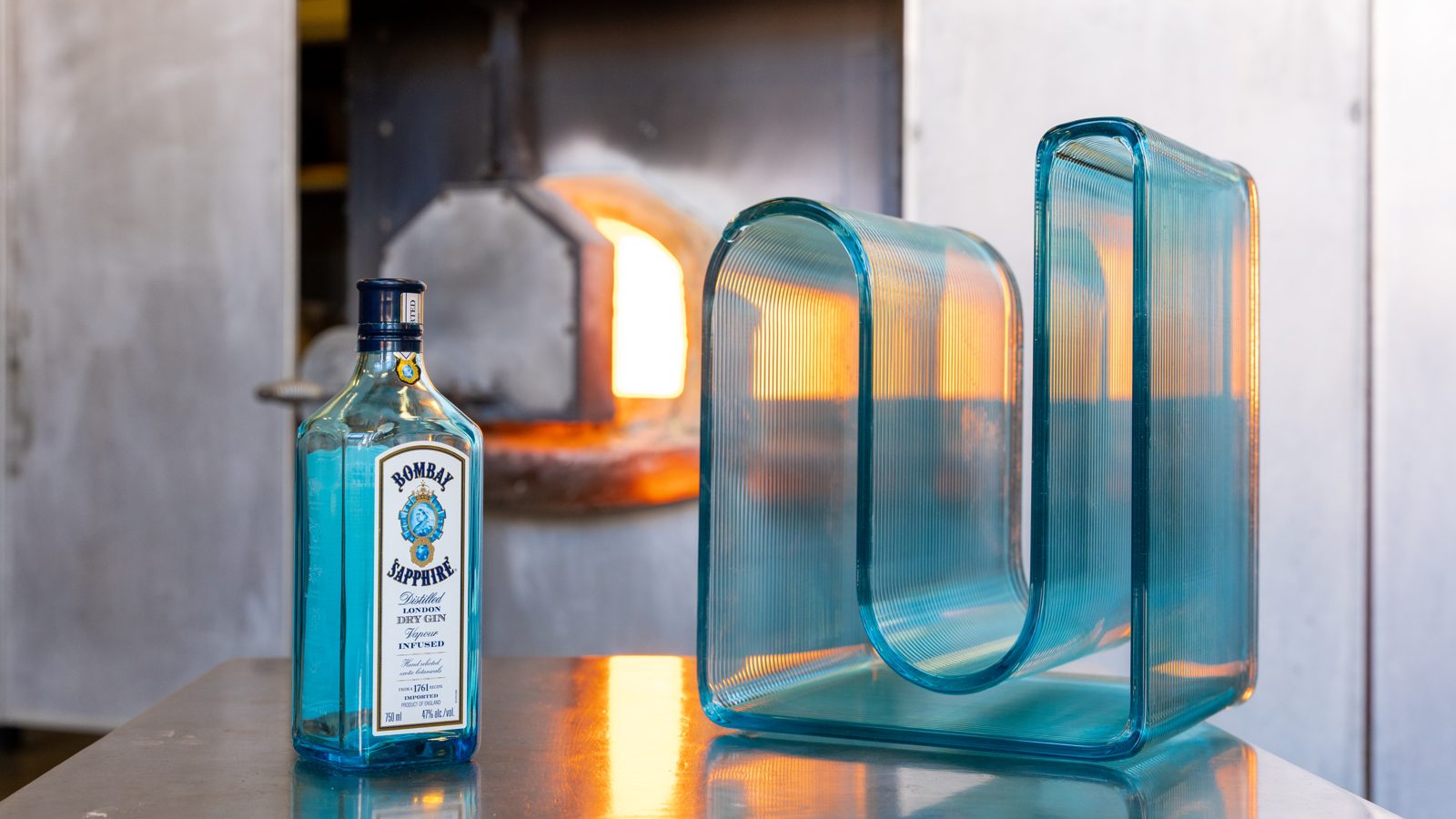
- Source post-consumer cullet. The bottle feedstock — “Sapphire” — is Bombay Blue L1 container glass from Glass Half Full in New Orleans; the window feedstock is Pilkington Optifloat, supplied direct to rule out contamination.
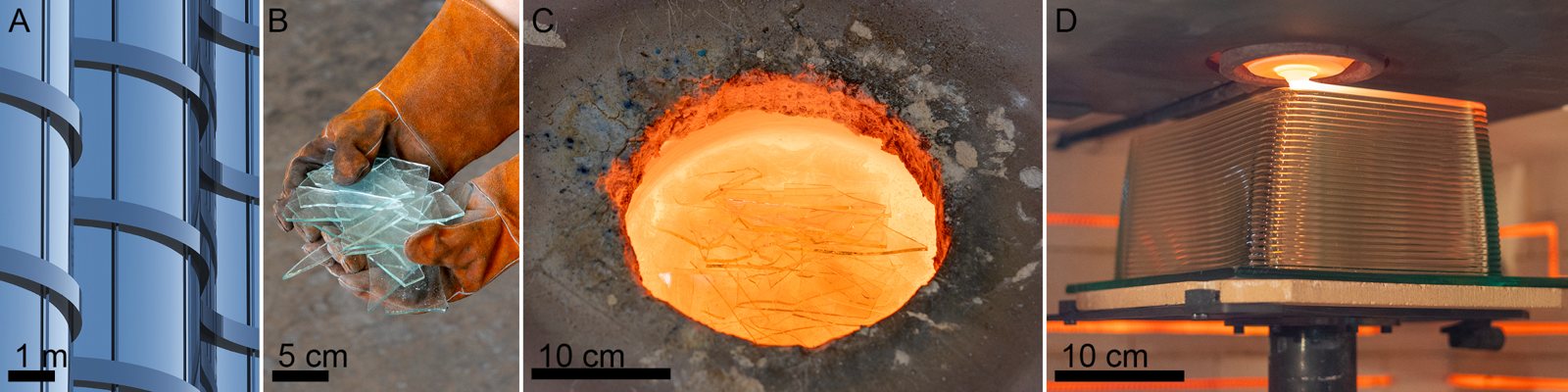
- Crush to a printable size. Container cullet is broken to roughly a 3.5 mm average particle diameter; float glass is hammer-crushed to pieces up to about 12 cm across.
- Calibrate by viscosity. Each composition is measured on a microprobe and its viscosity curve matched, predicting a working point near 1027 °C for Sapphire and 1023 °C for Optifloat — against 955 °C for studio glass.
- Melt and condition. Roughly 10 kg batches, each preheated to 621 °C, are charged into a double-wall crucible kiln one every 1.5 hours, then held at 1190 °C for 12 hours (float at 1218 °C).
- Print on G3DP3 with infrared feedback. The glass is hand-gathered and loaded, then extruded as a coil while a thermal camera trims the setpoints live — recorded print temperatures around 1045 °C for Sapphire and 1059 °C for Optifloat.
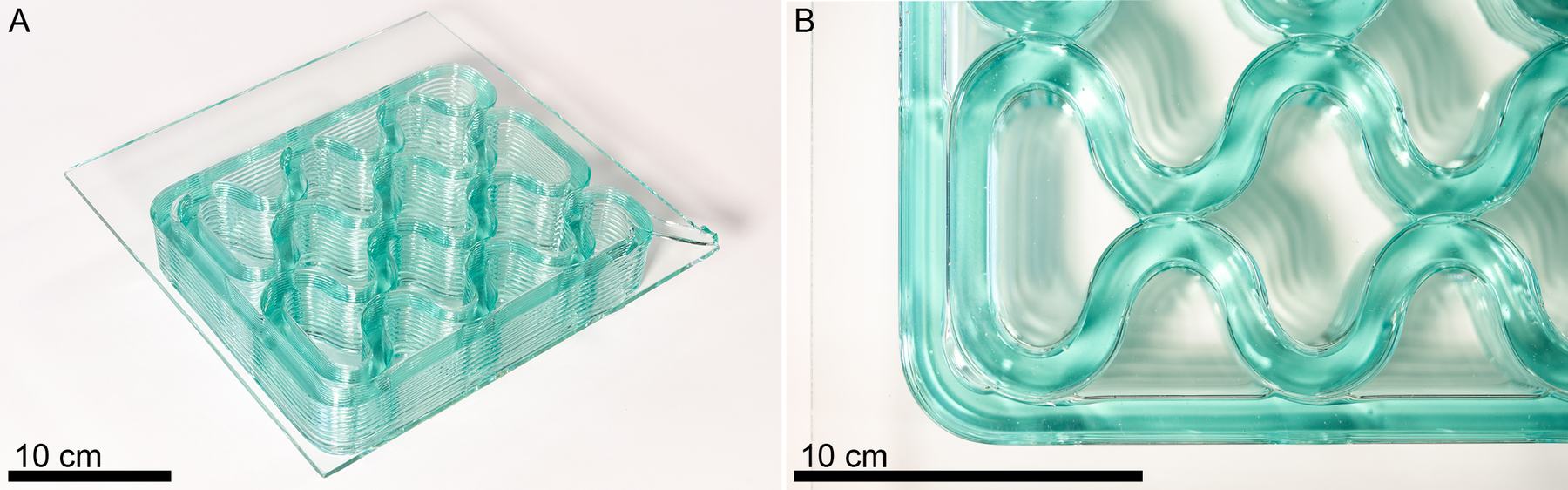
- Print float onto float. Recycled window glass is laid down directly onto preheated Optifloat sheets — possible because feedstock and substrate share a coefficient of thermal expansion — and demonstrated on coated products too.
- Anneal. The prints are cooled through the annealing point: about 550 °C for recycled float, 565 °C for bottle glass — recycled feedstocks anneal hotter, as they print hotter.
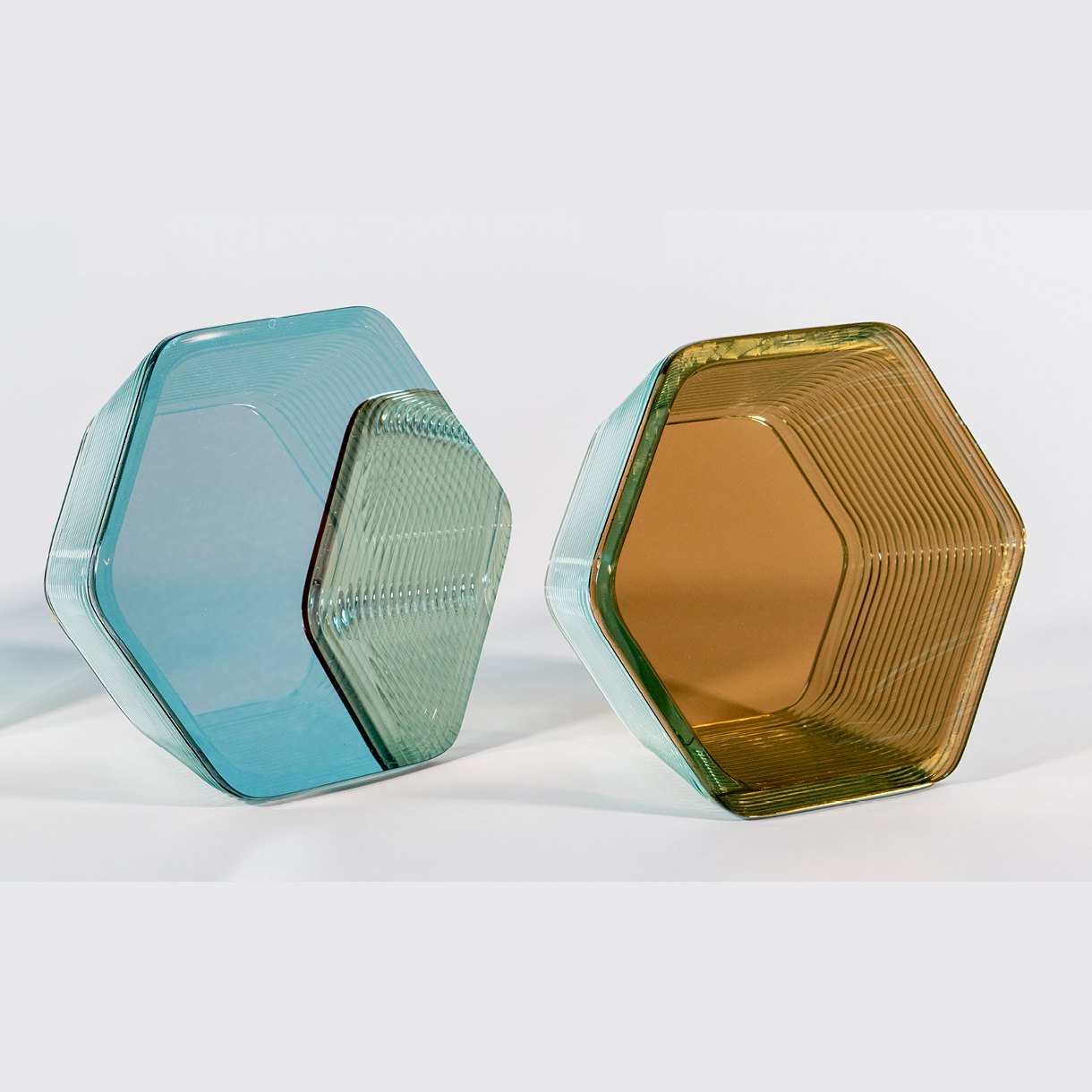
- Cut and characterize. Forms are cold-worked and sectioned; the hexagons are shown molten, then annealed, then finished, and float-on-float cross-sections expose how bead fuses to bead and bead to sheet.
The figures of this paper are objects in their own right — the feedstocks and prints the study was built from.